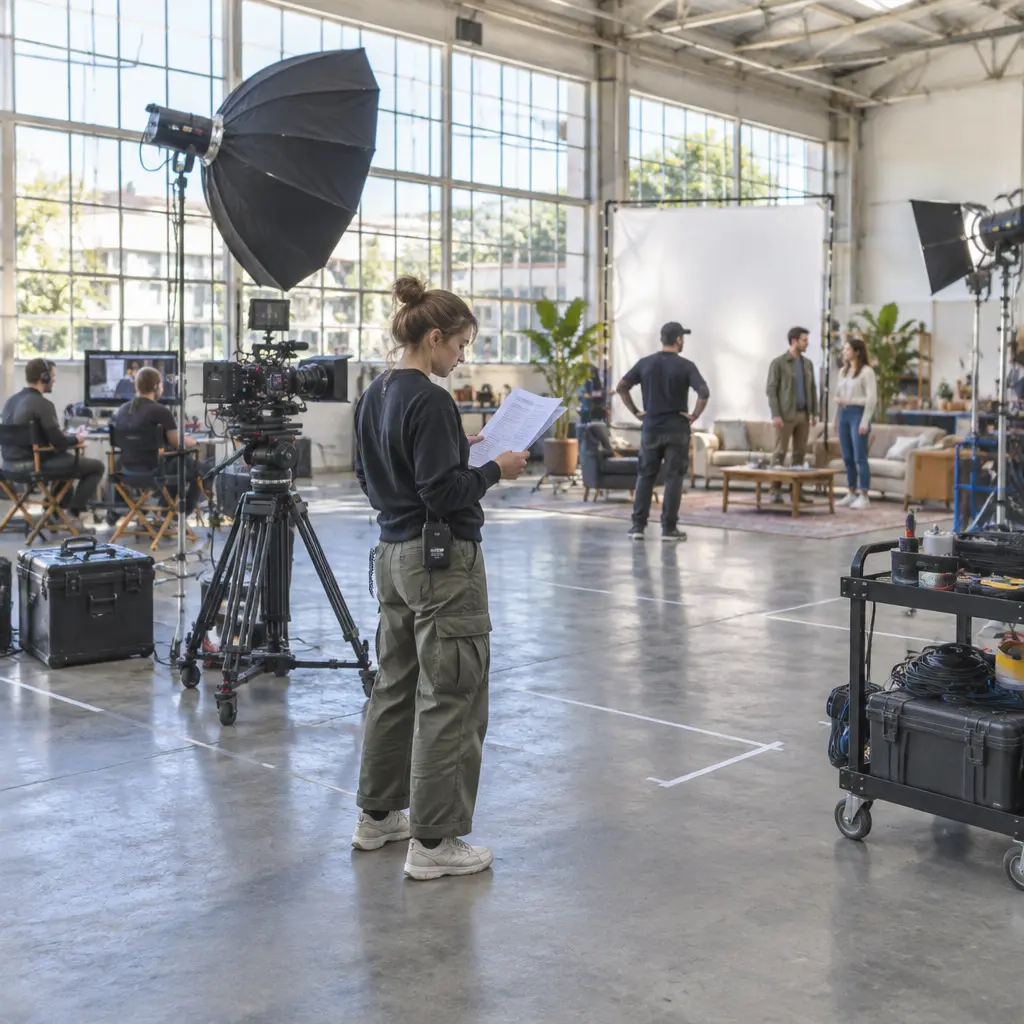
Commercial video pre-production is the planning work completed before filming: defining the brief, budget, schedule, creative approach, locations, cast, crew, equipment, and approvals. Streamlining that work helps prevent on-set delays by resolving uncertainties before they become costly production problems. The value is practical: the U.S. Bureau of Labor Statistics reports that film and video editors and camera operators work in environments where schedules can vary and production work may involve long or irregular hours, making efficient coordination important. A reliable workflow connects a clear brief to a feasible schedule, confirmed logistics, prepared departments, and a final readiness check.
Pre-production planning defines the commercial video workflow
Pre-production planning is the process of turning a production objective into an approved, executable plan before the crew arrives on set. The Producers Guild of America describes the producer’s work as spanning development, preparation, production, and post-production; in practice, that means aligning creative decisions with people, time, locations, and resources. For a commercial, the plan should also reflect the client’s business goal, brand requirements, intended audience, distribution channels, and delivery specifications.
The main forms of pre-production planning are creative planning, operational planning, and approval planning. Creative planning establishes what the audience should see and understand. Operational planning determines how the approved idea can be filmed. Approval planning identifies who must review scripts, casting, locations, rough cuts, and final deliverables—and when those decisions are due. Separating these related tasks makes ownership clearer and exposes dependencies before they threaten the shoot.
Creative brief and decision ownership
A creative brief is a concise document defining the commercial’s objective, audience, core message, tone, mandatory brand elements, deliverables, and success criteria. The Association of National Advertisers emphasizes the importance of clear marketing objectives and accountability; a production brief applies that discipline by translating campaign aims into decisions the production team can act on. For example, “increase awareness” is too broad to guide a shoot unless the team also knows which product benefit, audience, and call to action must appear.
The brief should name one decision-maker for each approval area, such as script, product claims, talent, wardrobe, and final edit. It should also identify who can provide feedback and who has authority to resolve conflicting comments. This prevents a common delay pattern: multiple stakeholders provide incompatible notes, while no one is empowered to approve a final choice.
Script, storyboard, and shot list
A production-ready script states the spoken copy, action, product interaction, graphics, and any required legal or brand language. A storyboard visualizes key moments, while a shot list converts those moments into camera setups and coverage. These are connected but distinct tools: the script defines what happens, the storyboard helps stakeholders agree on the visual idea, and the shot list helps departments prepare to capture it.
Reviewing these materials together can reveal practical problems early. A product demonstration may require a particular prop, a child performer may trigger additional work-hour rules, and a scripted exterior scene may depend on weather or permits. Locking the approved version and circulating it to the relevant departments reduces the risk of teams working from outdated instructions.
Scheduling and budgeting make the commercial video workflow executable
A production schedule is a time-ordered plan for completing preparation and filming; a budget assigns estimated costs to that plan. They must be developed together: a creative idea that cannot be completed within the approved time, crew, or budget is not yet an executable plan. The U.S. Small Business Administration’s guidance on project planning similarly emphasizes defining work, resources, costs, and milestones rather than treating a deadline as a plan by itself.
Commercial schedules commonly include script approval, casting, location scouting, permits, art preparation, equipment booking, production, editing, client review, and delivery. Their hyponyms include the pre-production calendar, the shooting schedule, and the post-production review calendar. Each should show dependencies, named owners, decision deadlines, and realistic time for revisions.
Schedule by dependencies, not just dates
Dependency scheduling identifies which tasks must finish before others can begin. For instance, a location cannot be confirmed until access and cost are approved; a final call sheet depends on confirmed cast, crew, location, and schedule. Mapping these links helps teams identify the tasks that can delay the entire project if they slip.
Build in time for approvals, travel, setup, company moves, meals, and expected resets. The U.S. Department of Labor notes that applicable federal rules restrict the hours of work for children under 16 in covered nonagricultural employment, while state rules may be more protective. When a production includes minors, the schedule must account for the relevant jurisdiction’s work-hour, education, supervision, and permit requirements rather than assuming an adult performer’s day plan will apply.
Budget contingencies and scope control
A production budget estimates costs for labor, equipment, locations, travel, art, insurance, permits, post-production, and other project needs. A contingency is a reserved amount for identified uncertainty, not a substitute for estimating known costs. The appropriate reserve depends on the production’s risk profile: a controlled studio shoot differs from a weather-sensitive exterior shoot involving multiple locations.
Scope control means documenting what is included in the approved production and how proposed changes will affect cost, schedule, or deliverables. If a client adds a new scene after the schedule is built, the producer should assess whether it requires additional cast, props, location time, coverage, or post-production work. Recording that impact before accepting the change helps avoid rushed decisions and unplanned overtime.
Logistics and risk checks protect the commercial video workflow
Production logistics are the arrangements that allow people, equipment, and materials to reach and work at the planned location safely and on time. They include access, parking, loading, power, permits, insurance, safety, catering, transport, and communications. These details may seem administrative, but a missing permit or an unusable loading route can stop filming just as effectively as an unapproved script.
Risk planning identifies conditions that could disrupt or endanger production and assigns a response. Relevant risks may include weather, illness, equipment failure, location restrictions, product availability, or late creative changes. The Occupational Safety and Health Administration recommends identifying workplace hazards and involving workers in safety planning; productions can apply that principle through location-specific briefings, clear reporting channels, and documented controls.
Location, permits, and access
A location scout evaluates a prospective site for visual suitability and operational feasibility. The evaluation should cover permitted filming areas, access times, sound conditions, lighting, power, parking, restrooms, weather exposure, public access, and restrictions on equipment or signage. A location agreement should clarify the authorized dates, areas, activities, fees, restoration expectations, and points of contact.
Permit requirements differ by municipality, property owner, activity, and production footprint, so there is no universal permit deadline or fee. The producer should verify requirements directly with the relevant film office or authority and record confirmation. For public streets or parks, plans may also need to address traffic control, pedestrian access, insurance certificates, and neighborhood notification.
Safety, insurance, and contingency planning
A production risk assessment records hazards, who may be affected, and the controls intended to reduce risk. Depending on the shoot, controls may include cable covers, rain protection, safe lifting plans, crowd management, first-aid arrangements, or a qualified specialist for stunts and other higher-risk work. The U.S. Occupational Safety and Health Administration’s recommended practices for safety and health programs call for hazard identification, prevention, and worker participation—useful principles for any production’s safety plan.
A contingency plan specifies what the team will do if a key assumption fails. Examples include an alternate interior location for rain, a backup product unit, spare media and batteries, and an escalation contact for urgent approvals. The plan should identify who makes the call, what decision deadline applies, and how the change affects the schedule and budget.
Department coordination turns planning into on-set readiness
Department coordination is the exchange of accurate, current information among production, camera, lighting, art, wardrobe, sound, talent, and client teams. It connects the approved creative plan to the specific work each department must complete. A production can have a strong script and schedule yet still lose time if a department receives a different version or learns about a requirement too late.
Useful coordination tools include a shared production folder, version-controlled documents, contact lists, a production design reference, and a call sheet. These tools are most effective when one person owns each document, revision dates are visible, and outdated versions are clearly marked. The goal is not to generate more paperwork; it is to make the correct information easy to find.
Call sheets and production packets
A call sheet communicates the day’s schedule and essential logistics to cast and crew. It typically includes call times, location address, parking and access instructions, weather information, scene details, meal plans, emergency contacts, and any department-specific notes. A production packet can add the approved script, shot list, location information, safety notes, and relevant reference images.
The call sheet should be issued only after critical details have been checked, and updates should be sent through an agreed channel. A clear revision process matters because a changed call time or entrance can affect every department. For privacy and security, distribute personal contact information only to people who need it for production.
Pre-shoot meeting and readiness review
A pre-shoot meeting is a final coordination discussion in which department leads review the plan, outstanding questions, and decision paths. It should confirm the shooting order, location access, talent and product readiness, technical requirements, safety responsibilities, and client approval arrangements. The meeting is also an opportunity to identify discrepancies between the creative plan and what departments can actually deliver.
A readiness review can use a simple go/no-go checklist: approved script and boards; confirmed cast and crew; secured location and permissions; available props and product; equipment plan; safety briefing; schedule and contact sheet; and backup decisions for significant risks. If an essential item is unresolved, the producer can assign an owner and deadline—or escalate the issue before the crew is committed to the day.
A streamlined commercial video workflow prevents avoidable delays
A practical workflow moves from objective to verified readiness in a controlled sequence. Each stage should have a decision owner, an approved output, and a clear handoff to the next stage. This reduces the likelihood that unresolved creative choices will surface during filming, when changes tend to affect more people and resources.
- Define the campaign objective, audience, message, deliverables, and success criteria.
- Approve the script, visual approach, product requirements, and decision-makers.
- Build a feasible schedule and budget, including dependencies and contingency.
- Confirm cast, crew, locations, access, permits, equipment, and safety arrangements.
- Distribute controlled production documents and hold a department readiness meeting.
- Resolve remaining blockers, issue the final call sheet, and confirm the plan with key stakeholders.
Measure the process using project-specific indicators rather than assuming one benchmark fits every production. Useful measures include the number of unresolved decisions at the readiness review, schedule changes caused by preventable preparation gaps, overtime attributable to planning issues, and the proportion of deliverables approved on the planned review dates. Recording these measures across projects helps identify recurring bottlenecks and improve future estimates.
A small product shoot may need only a concise brief, a one-day schedule, and a checklist. A multi-location campaign with talent, complex art, or substantial client review may require a detailed production book and formal risk assessment. In both cases, the principle is the same: right-size the process, make decisions visible, and confirm the dependencies that could stop work.
Conclusion: prepare decisions before the commercial video shoot
Commercial video pre-production works best when the brief, schedule, budget, logistics, safety planning, and department communications are treated as one connected system. A clear brief establishes what the production must achieve; dependency-based scheduling and scope control make that goal feasible; logistics and risk checks protect the plan; and a final readiness review ensures teams arrive with consistent information.
The broader benefit is not simply a smoother shoot. Strong preparation helps protect creative quality, crew safety, client confidence, and production resources. Start by reviewing a recent project for delays caused by late approvals, missing information, or untested assumptions. Then add one measurable checkpoint to the next production workflow and refine it using the results.
Sources: U.S. Bureau of Labor Statistics, Film and Video Editors and Camera Operators, Occupational Outlook Handbook, https://www.bls.gov/ooh/media-and-communication/film-and-video-editors-and-camera-operators.htm; Producers Guild of America, Code of Credits, https://www.producersguild.org/page/code; Association of National Advertisers, ANA, https://www.ana.net/; U.S. Small Business Administration, Plan Your Business, https://www.sba.gov/business-guide/plan-your-business; U.S. Department of Labor, Child Labor Provisions for Nonagricultural Occupations Under the Fair Labor Standards Act, https://www.dol.gov/agencies/whd/fact-sheets/43-child-labor-non-agriculture; Occupational Safety and Health Administration, Recommended Practices for Safety and Health Programs, https://www.osha.gov/safety-management